Panacea Bio Chem
THE PANACEA
ADVANTAGE
Beyond conventional vials, dual-chamber cartridges and premixed pens.
THE CARTRIDGE IS ONLY THE BEGINNING.
For professional in vivo and in vitro laboratory research only
01 · The proposition
The cartridge is only the beginning.
What distinguishes a Panacea product is the engineering, chemistry, manufacturing process, protective environment, analytical quality and formulation intelligence behind it.
Four categories of product are often compared as if they were the same. They are not. Each is shown here by what it actually is.
Freeze-dried product in a single container, sealed under vacuum: a sound way to keep a peptide dry.
Everything after that is left to the user: a separately bought diluent such as bacteriostatic water, syringes, transfers, volumes and calculations.
Two chambers separated by a moving plunger, with a bypass for reconstitution inside the cartridge. It spares the user one task: drawing the liquid from a second vial.
It gives up the vial's vacuum to do so. The cake chamber holds air, the cake is freeze-dried resting on the middle plunger, and an air bubble travels with the liquid. Air on both sides of the plunger is oxygen, and oxygen drives the oxidation of the peptide.

Panacea's proprietary integrated dry-peptide preservation and reconstitution platform: a separately prepared lyophilised cake, sealed under vacuum with an argon backfill, and an engineered P‑EARLs™ liquid (Panacea-Engineered Aseptic Reconstitution Liquids) in a precision dual-chamber cartridge.
Formulated with Dicoias Ψ™, Peptourbillon™ and RedoxVault™. Dried in the Lyochrysalis™ under S3Pulse™: LyoLevit™, Cryolapse™, TgShift™, DiastolVAC™, RF Tunnel™. Closed with PleniDose™, OxyDeplete™, ArgonLock™, VANA™ with ElimiVoid™, and SealoPrester™. Delivered with the EZnject™ pen and IncreSure™.

Panacea's advanced liquid-cartridge platform. The active ingredients are kept in solution, in an engineered formulation.
Formulation chemistry, precisely controlled filling, oxygen depletion, argon conditioning, a cartridge with no gas pocket and dose-fidelity engineering. Not merely an ordinary premixed pen.
Formulated with Dicoias Ψ™, Peptourbillon™ and RedoxVault™. Filled with PleniDose™ with ElimiVoid™, and Cryoviscous™. Protected by OxyDeplete™ and ArgonLock™. Delivered with IncreSure™.
A cartridge's physical shape is only one part of product quality. Panacea offers an integrated technological architecture — not merely a cartridge filled with peptides and bacteriostatic water.
02 · Lyoprester®
Lyoprester® and its longevity
Lyoprester® combines a below-zero desorption finishing stage, a dry cake sealed under vacuum with an argon backfill, and a separately stored, peptide-specific P‑EARLs™ reconstitution liquid with dissolved argon. Together they remove the main causes of peptide degradation: residual moisture, oxygen, unsuitable reconstitution chemistry and long storage in solution.
Ordinary freeze dryers end with a +40 to +60 °C bake to drive off the last bound water. The Lyochrysalis™ never overheats a cake: TgShift™ raises the glass-transition ceiling so the cake dries with its structure intact, and the final desorption is completed a few degrees below zero. The peptide leaves the dryer with its binding affinity and bioavailability preserved.
Controlled freezing is a deliberate step inside Panacea's lyophilisation process. The finished product is never frozen: it is kept dry, sealed and protected. Greater storage flexibility, and no freezer.
Sealed: five years at room temperature, eight years refrigerated. After reconstitution: six months refrigerated, forty days at room temperature. These are the storage figures of the genuine Lyoprester® system with its matched P‑EARLs™ liquid; no generic vial and no generic dual-chamber cartridge carries them. Ordinary room lighting does it no harm; direct sunlight does.
03 · The manufacturing difference
The cake is engineered — not freeze-dried on the middle stopper.
Every other laboratory lyophilises with a middle elastomer stopper already installed in the cartridge. The peptide solution is deposited directly over this stopper, then frozen and dried with the product resting on it.
Panacea does not manufacture the Lyoprester® cake that way.
In Panacea's process no plunger is in the cartridge while the cake is made. The peptide solution is aliquoted, frozen and dried on glass, levitating in the Lyochrysalis™; both plungers enter only after lyophilisation is complete.
Every other laboratory
Mouth up, the middle stopper already installed. The peptide solution is deposited over it, then frozen and dried resting on the elastomer (contact line). The cake stays on that stopper for the whole shelf life.
The Panacea sequence
Mouth down. The peptide solution rests in the head of the cartridge, on glass. No plunger is in the cartridge.
Frozen and dried there, in the Lyochrysalis™. The cake forms on glass.
Argon is admitted over the finished cake (ArgonLock™).
Only now does the middle plunger enter, onto a finished cake. The P‑EARLs™ liquid is dispensed onto it.
Vacuum through the mouth, then a controlled fraction of argon. The top plunger and the cap are fitted together.
Mouth up. The final mechanical seal closes the cartridge.
Steps 4 and 5, in motion

The cartridge stands mouth down, the finished cake in its chamber and the middle plunger above it. The P‑EARLs™ liquid is aliquoted while vacuum draws the gas from the cake's chamber; argon is then admitted to both chambers, and the top plunger and the cap are fitted together. No air bubble is left in the liquid.
Drawings: schematic sections, each cartridge standing as it stands at that step. References: dual-chamber lyophilisation and container materials — PMC8575750; PMC11744310; PubMed 28928293 (see Technical references).
04 · P‑EARLs™
Panacea-Engineered Aseptic Reconstitution Liquids
No air bubble. No generic diluent. No unnecessary exposure.
Panacea's P‑EARLs™ liquid is engineered for the peptide it dissolves, oxygen-depleted, argon-conditioned and enclosed between precision plungers with no air bubble. With the sealed cartridge and its own buffering, it keeps oxygen away from the peptide and its pH steady through storage.
Every other liquid cartridge carries a gas bubble. A bubble is a reservoir of oxygen and a gas–liquid interface, and a dissolved peptide degrades at both.
Completing a liquid chamber plunger to plunger, with no gas phase left in it, cannot be done on standard filling equipment. Panacea spent a year and a half designing and building the machines that do it. Nobody else made that investment, and nobody else has the result.
A conventional liquid chamber with its gas pocket. The pocket is a reservoir of oxygen and a gas–liquid interface.
P‑EARLs™ chamber. Engineered liquid from plunger to plunger: oxygen removed by OxyDeplete™, argon held dissolved by ArgonLock™, no gas pocket.
A world first. Panacea Bio Chem is the first manufacturer, and the only one, to complete a peptide dual-chamber cartridge with an engineered, oxygen-depleted, argon-conditioned liquid and no air bubble.
Drawings: schematic sections of the liquid chamber. Edition of November 2026.
05 · Oxygen, reactive oxygen species and redox protection
Engineered oxygen depletion. Multi-layer oxidative protection.
Panacea Bio Chem approaches peptide oxidation at several levels: removing oxygen during processing, eliminating internal gas reservoirs, establishing protective argon conditions and controlling molecular interactions through formulation engineering.
Methionine, cysteine, tryptophan and other sensitive residues oxidise. The reactions are driven by dissolved molecular oxygen, hydroperoxides, free radicals, light and trace metals.
| Technology | What it does |
|---|---|
| OxyDeplete™ | Removes dissolved and entrained oxygen from the liquids before they are sealed. |
| ArgonLock™ | Controlled argon conditioning. In the dry-cake chamber it operates with vacuum-derived low-pressure conditions and controlled argon admission. In P‑EARLs™ and Liquiprester™ liquids, argon is held in dissolved form, not as a heavy-gas blanket sitting on the liquid. |
| ElimiVoid™ | Completes the liquid chamber with no gas pocket. Built into VANA™ for the Lyoprester®, into PleniDose™ for the Liquiprester™. |
| RedoxVault™ | Redox protection built into the formulation. Lipid microsphere encapsulation holds a reactive active in its own micro-reservoir, so compounds that would attack each other coexist in one formulation. |
| P‑EARLs™ | The right chemical environment for each peptide: buffering and compatibility set at manufacture. |
These technologies work together: they remove the conditions that promote oxidation and suppress ROS-mediated degradation. Argon acts through its inertness and by displacing the oxygen available to the peptide.
Reference: peptide oxidation and aqueous stability — PMC10056213 (see Technical references).
06 · Peptourbillon™ · VANA™ · LyoLevit™ · the engineering ecosystem
Formulation and manufacturing intelligence

Panacea's single-, dual- and multi-layer formulation architecture. Different formulation components or active ingredients are prepared and arranged in deliberate layers, rather than every component being mixed into a single homogeneous bulk liquid before freezing.
The layers serve manufacture and storage; on complete reconstitution the components dissolve together.

Vacuum–Argon–Nitrogen Architecture
Cake side. Argon is introduced following lyophilisation; the VANA™ Machine subsequently establishes the final reduced-pressure, partially argon-conditioned dry chamber during sealing — not a cartridge simply filled with argon at atmospheric pressure.
Liquid side. P‑EARLs™ and Liquiprester™ liquids are separately degassed and argon-conditioned, without depending on a retained visible headspace bubble.
An integrated, chamber-specific preservation strategy.

Zero-contact orbital levitation: a vapour-supported, high-spin sublimation state without solid surface support. The cake levitates and spins in high orbit while it dries.
Layer placement is Peptourbillon™; levitated drying is LyoLevit™.
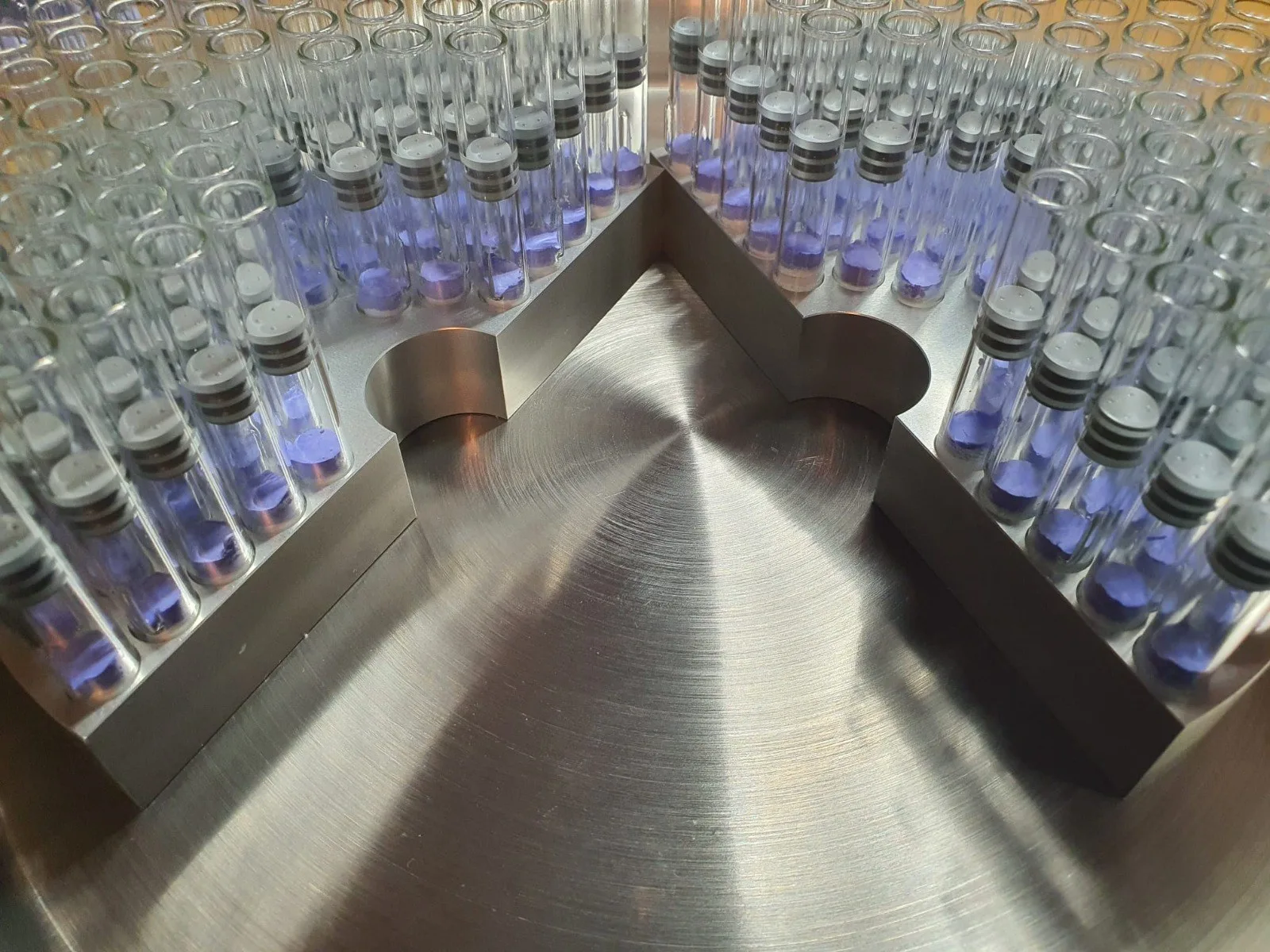
| Lyochrysalis™ | Panacea's own peptide lyophiliser — one instrument running the Panacea gentle-drying technology stack. |
| S3Pulse™ | The process-control algorithm that runs the Lyochrysalis™ through freezing, primary sublimation and secondary desorption. |
| Cryolapse™ | Panacea's secondary-vacuum lyophilisation method for gentle, surfactant-free freeze-drying of sensitive peptides. |
| CryoSurge™ | The nucleation-induced crystallisation exotherm of a freezing formulation, recorded per product holder as onset, peak and return. |
| CryoFlare™ | The product-temperature signature of heating that runs ahead of the ice during sublimation. S3Pulse™ detects and records it, and the heating ramp that caused it is never used again. |
| DiastolVAC™ | Biomimetic vacuum control — pumps, valves and sensors governing chamber pressure by gentle difference rather than brute force. |
| TgShift™ | One process across two stages, with radio-frequency and ultrasound. “Teach them young”: during the ultra-low-temperature freeze it opens the RF Tunnel™; during sublimation it raises the glass-transition temperature (Tg′), so drying proceeds with the cake intact. The run finishes cold, a few degrees below zero, never in a hot bake. |
| Dicoias Ψ™ | Panacea's formulation mathematics: it computes the recipe of every peptide liquid and every P‑EARLs™ liquid. |
| SealoPrester™ | Aseptic cartridge closure: the final mechanical seal after the VANA™ vacuum/argon cycle. |
| RF Tunnel™ | Reconstitution pathways: a channel through the cake, opened while it freezes, so it redissolves from its core and its surface at once. |
| IncreSure™ | Dose-fidelity engineering: verified active content per pen increment. |
06 · Dicoias Ψ™ — the formulation decides
What travels with an active decides what the body receives.
Take a medicine with a glass of grapefruit juice. The dose on the label is unchanged; the amount that reaches the blood is not. Furanocoumarins in the juice remove CYP3A4, the enzyme of the intestinal wall that destroys part of the dose before it is absorbed.
One whole fruit or 200 mL of juice is sufficient; a quarter of the effect remains 24 hours later; more than 85 medicines are affected.⁴ Nothing was added to the medicine. Only its company changed.
The grapefruit is a comparison, used here to make the principle easy to see. It is not how peptides work. An injected peptide never meets the intestinal wall or CYP3A4. Its fate is decided in its own liquid: charge, folding, aggregation, oxidation, solubility. The mechanism is different; the principle is the same.

This is what Dicoias Ψ™ calculates. Nothing in a formulation is neutral. pH, counter-ion, buffer, sugar, surfactant, dissolved gas, trace metal: each one moves the charge of the active, its folding, its aggregation, its oxidation and its solubility at the moment it is needed. The industry settles these by habit and by trial. Panacea computes them.
Dicoias Ψ™ writes every active and every excipient as a vector on the same six axes: electrostatic proximity (pI window), net-charge burden at pH, aggregation & interfacial stress, chemical & oxidative liability, solid-state / matrix dependence, molecular crowding / viscosity. It rejects any recipe that breaks a hard limit before a score is given, scores every recipe that remains, and prescribes the additions that close the distance to the best one.
Grapefruit juice changes a medicine by accident. Dicoias Ψ™ sets the company of every Panacea active by calculation.
¹ Bailey DG et al., Lancet 1991;337:268–9. ² Lilja JJ et al., Clin Pharmacol Ther 1998;64:477–83. ³ Lown KS et al., J Clin Invest 1997;99:2545–53. ⁴ Bailey DG et al., CMAJ 2013;185:309–16. ⁵ Buckley ST et al., Sci Transl Med 2018;10:eaar7047. ⁶ Heise T et al., Clin Pharmacokinet 2017;56:551–9.
06 · Peptourbillon™ — several actives, one cartridge
The industry uses two containers. Panacea uses one cartridge.
Two actives rarely want the same liquid. Each has its own pH, its own stability window and its own enemies; blended into one bulk solution, one of them pays. The industry's answer is to keep them apart, and to hand the user two of everything.
Its two components are “injected separately with a dual-chamber pen device”.¹ In 2026 the work on a single-chamber device was abandoned.² Two liquids, two chambers, one of the largest development budgets in the industry.
Pramlintide is formulated at about pH 4, insulin near neutral. The two are never mixed: separate syringes, separate injection sites, at every meal.³
Two chambers, two syringes, two injections. After decades of work, the answer to an incompatibility is still to pass both halves of it to the person holding the pen.
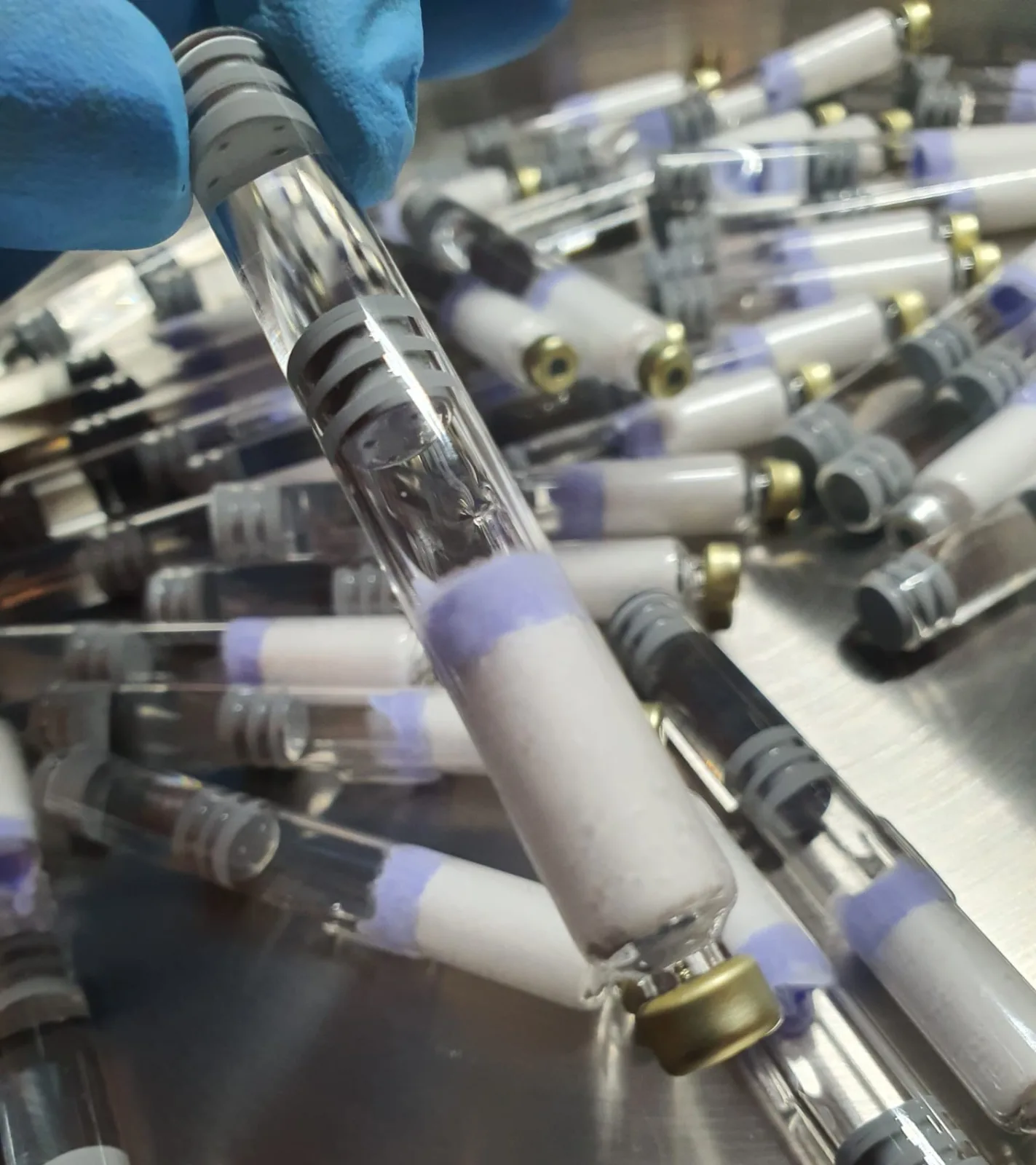
TelomeREGEN, after the lyophilisation run. One cake, two layers, in the cake chamber of each Lyoprester®: the blue layer is GHK‑Cu2+, the white layer is Pineal Gland Peptide T‑38. Two actives, one cartridge, one injection.
Peptourbillon™ is layered lyophilisation: each active in its own layer of one freeze-dried cake. Dual-layer for two actives; multi-layer for three or more. Every layer is formulated for the active it carries: its own pH, its own protectants, its own place in the cake. Dry, the layers do not react with each other. They meet only at reconstitution, minutes before use, in a P‑EARLs™ liquid computed for that meeting.
| Product | Layers and actives, in one cartridge |
|---|---|
| TelomeREGEN | Dual-layer. Pineal Gland Peptide T‑38 + GHK‑Cu2+. The first. |
| GonadoTROPINEX | Multi-layer, three layers. Human GnRH + Vasoactive Intestinal Peptide + Oxytocin |
| ExADIPO² | Dual-layer. Tirzepatide + Selank |
| ExADIPO³ | Dual-layer. Retatrutide + Oxytocin |
| HealCONEX | Dual-layer. Thymosin β4 + Bepecin |
| NocTANEX | Multi-layer, three layers. Bremelanotide + Melanotan II + Oxytocin |
¹ BioPharma Dive, 20 December 2024, “Novo's next-gen obesity drug misses expectations in closely watched trial”. ² Fierce Biotech, 2026, “Novo CEO insists ‘no change in plan’ for CagriSema launch after single-chamber device ditched”. ³ Symlin (pramlintide acetate) prescribing information: not to be mixed with insulin; administered as separate injections.
07 · Reconstitution and measurement
Fewer preparation operations. Fewer opportunities for error.

Activation is internal: the vacuum of the cake chamber draws the P‑EARLs™ liquid through the bypass, inside the closed cartridge.
110 increments span a nominal mechanical displacement range of 1.10 mL.

A separate configuration: a special top plunger accommodates a syringe piston and a needle adaptor, turning the cartridge itself into a complete, self-contained system. The lyophilised cake rests in its chamber under argon while the P‑EARLs™ liquid waits in the second chamber, behind the middle plunger.
Its own mechanism, separate from the EZnject™ pen.
Compared with conventional vial preparation, the integrated system removes:
The advantage is fewer preparation operations and fewer opportunities for error, with nothing given up in preservation: the cake remains sealed under vacuum, exactly as in a classical lyophilised vial, and an argon backfill is added on top of that vacuum (VANA™, ArgonLock™).
“Why not just buy a conventional peptide vial?”
Because Lyoprester® keeps what is right about the vial, a dry cake sealed under vacuum, and adds what the vial lacks: an argon backfill over the cake, reconstitution inside the closed cartridge, a liquid matched to the peptide's chemistry, and none of the preparation steps. The customer receives a complete engineered system, not a container and a preparation task.
07 · Reconstitution, in motion
One tap. Or one push.

One tap starts it. Both plungers advance until the middle plunger sits in the bypass; the vacuum of the cake chamber then draws the P‑EARLs™ liquid over it and into the cake. Core and surface dissolve together, with no air bubble, and the argon backfill remains.

The cartridge is the whole injection system. Needle on, needle up, push the rod: the P‑EARLs™ liquid enters the cake's chamber while the argon leaves through the needle. A few droplets at the tip, and it is ready to inject.
The on-screen edition plays both sequences; in print each drawing shows its device as stored. The same animations run on lyoprester.com.
08 · Vial · standard dual-chamber · Lyoprester®
Why not buy an ordinary dual-chamber cartridge?
| Feature | Conventional vial | Standard dual-chamber cartridge | Genuine Lyoprester® |
|---|---|---|---|
| Atmosphere over the dry cake | Vacuum | Air | Vacuum, plus an argon backfill — VANA™ + ArgonLock™ |
| Where the cake is freeze-dried | On glass | Resting on the middle plunger, and in contact with it through the shelf life | Levitating, on no plunger — LyoLevit™. Both plungers enter after drying |
| The bypass at reconstitution | No bypass | Product dried into the plunger's ribs obstructs it: slow, incomplete reconstitution | Clean: no product was ever dried on a plunger |
| What moves the liquid into the cake | The user, with a syringe and a needle | The user's push on the plunger | The vacuum of the cake chamber: the cartridge reconstitutes by itself |
| Dry formulation and liquid in one container | No | Yes | Yes |
| Reconstitution liquid | Bought separately: bacteriostatic water | A general diluent | P‑EARLs™, made for the peptide it dissolves |
| Gas in the liquid | Air enters at every transfer | A gas bubble travels with the liquid | None: the liquid chamber is completed with no air |
| Dissolved oxygen in the liquid | Not removed | Not removed | Removed — OxyDeplete™, with argon held dissolved |
| Dose consistency | Depends on the user's measuring and calculation | Inconsistent when the bypass is obstructed, with a stiff injection stroke | EZnject™: 110 indexed increments of 0.01 mL |
| Formulation | One blended bulk solution | One blended bulk solution | Peptourbillon™ layers computed with Dicoias Ψ™; RedoxVault™ lipid microsphere encapsulation |
| Final drying | Commonly a +40 to +60 °C secondary bake | Commonly a +40 to +60 °C secondary bake | Finished a few degrees below zero — Lyochrysalis™, TgShift™ |
| Sealed shelf life | Protected by its vacuum; kept refrigerated or frozen | Shorter than a vial's: air in the cake chamber | Up to 5 years at room temperature, up to 8 years refrigerated |
| After reconstitution | Short: a solution in a punctured vial | Short: a general diluent, and air in the cartridge | Up to 6 months refrigerated, up to 40 days at room temperature |
protects the peptide works against it
The standard dual-chamber cartridge spares the user one task: drawing the liquid from a second vial. It pays for that with the vial's best property. Its cake chamber holds air where the vial holds vacuum. Its cake is dried resting on the middle plunger, and product dried into the plunger's ribs obstructs the bypass: reconstitution becomes slow and incomplete, doses inconsistent and the injection stroke needlessly stiff. For stability and shelf life the classical vial is the better of the two. Lyoprester® keeps the vial's vacuum, adds an argon backfill, and removes every step the vial leaves to the user.
09 · Introducing Liquiprester™
The glass may vary. The dose must not.
LIQUIPRESTER™ — NOT SIMPLY PREMIXED. PRECISION-ENGINEERED.
Panacea's advanced liquid-cartridge platform. Unlike Lyoprester®, the active ingredients are kept in solution, in an engineered formulation. Liquiprester™ combines formulation chemistry, precisely controlled filling, oxygen depletion, argon conditioning, a cartridge with no gas pocket and dose-fidelity engineering.
“Isn't this just another premixed pen?” No. A conventional premixed pen keeps its peptide with preservative chemistry: phenol, with propylene glycol or benzyl alcohol. Liquiprester™ keeps it by removing what degrades it. The oxygen is taken out, argon is dissolved in, no gas pocket is left, and each reactive active is protected in its own lipid micro-reservoir. Every recipe is computed with Dicoias Ψ™, for the best outcome without compromise.
¹ Mounjaro KwikPen and Ozempic pre-filled pen: Summaries of Product Characteristics, sections 6.1, 6.3 and 6.4 (sources on the next page).
10 · Liquiprester™ preservation
Liquiprester™ — up to five years of engineered liquid preservation at 2–8 °C
An advanced liquid-peptide preservation platform incorporating oxygen reduction, dissolved argon conditioning, bubble-free liquid containment and formulation-specific molecular protection.
Unopened · refrigerated storage · months
Why it lasts
Oxygen reduction in the liquid.
Dissolved argon conditioning.
Bubble-free containment.
Lipid microsphere encapsulation: each reactive active in its own micro-reservoir.
The comparison is unopened refrigerated storage against unopened refrigerated storage, each figure from its manufacturer's own product information. The reference pens reach their periods with phenol and propylene glycol or benzyl alcohol in the liquid; Liquiprester™ reaches five years without that chemistry. Its figures are its own, separate from the dry-state Lyoprester® figures.
Sources: Mounjaro KwikPen (tirzepatide) SmPC section 6.3 “Before use 24 months”, store at 2–8 °C, revised 29 August 2026, medicines.org.uk/emc/product/15484; Ozempic pre-filled pen (semaglutide) SmPC section 6.3 “Before first use … 3 years”, store at 2–8 °C, revised July 2026, medicines.org.uk/emc/product/9750. Excipients, section 6.1 of the same documents: Mounjaro KwikPen includes glycerol, phenol and benzyl alcohol; Ozempic includes propylene glycol and phenol. Liquiprester™: Panacea Bio Chem specification.
11 · The complete Liquiprester™ technology stack
Precision filling, protective atmosphere, engineered chemistry

Precision filling architecture with a controlled rear-plunger datum and a defined active-content aliquot, keeping cartridge geometry, total liquid content, pen mechanism and intended dose mapping in their proper relationship. The published design describes a target 3.00 mL primary aliquot within a defined tolerance, followed by controlled completion.

Completion of the remaining liquid space with no bubble left in it, without shifting the rear plunger and without losing a drop of active liquid. Customer value: a more tightly controlled liquid-containing environment.

A controlled low-temperature, higher-viscosity processing condition within the liquid preparation and completion sequence. It holds the active-containing liquid still, damping convection and intermixing, so the completion step can be carried out above it with precision.

Reduction of dissolved and entrained oxygen, then argon conditioning of the prepared liquid — argon held in dissolved form, not as a heavy-gas blanket.

Dose-fidelity engineering that considers cartridge geometry and the relationship between pen movement, actual liquid delivery and active content — addressed across the start, middle and end of the stroke and across cartridge and pen variations. A defining engineering principle, backed by measurement.

Molecular protection by lipid microsphere encapsulation: each active in its own micro-reservoir, so several peptides share one liquid without attacking each other.
Peptourbillon™ in liquid form. Sophisticated co-formulations in which multiple actives coexist within a deliberately engineered liquid environment — compatibility engineering and selected protective molecular compartments, rather than the assumption that combining peptide solutions creates a stable product.

P‑EARLs™ expertise. Panacea's liquid-formulation expertise in pH management, chemical compatibility, buffering and controlled formulation conditions. Each Liquiprester™ formulation has its own engineered liquid chemistry.
The glass may vary. The dose must not.
12 · Quality and engineering assurance
Supported by analytical science, not only by packaging
| Quality attribute | Scientific relevance |
|---|---|
| Residual moisture | Low residual moisture limits water-dependent degradation in the freeze-dried matrix. |
| Dry-chamber residual oxygen | Vacuum with an argon backfill keeps oxygen away from the cake through storage. |
| Dissolved oxygen in liquids | Removing the oxygen removes the reactant behind oxidative degradation. |
| Bubble-free liquid completion | No internal gas reservoir and no gas–liquid interface. |
| pH consistency | Buffering, gas control and chemical compatibility keep the pH where it was set. |
| Cartridge closure integrity | Preserves compartment separation and the protective internal conditions. |
| Reconstitution time and active recovery | Demonstrate whether the integrated formulation dissolves appropriately and retains its intended active content. |
| HPLC and LC-MS analysis | Support identity, assay, chemical purity and related-substance characterisation. |
| Extractables and leachables | Explain why product-contact materials and the manufacturing contact sequence matter. |
| Delivered-volume accuracy | Characterises actual pen/cartridge delivery instead of relying solely on nominal mechanical increments. |
| In-use stability | The condition of the formulation after reconstitution or first use. |
| Sterility | A microbiological quality attribute, assessed on its own. |
| Endotoxins | Require their own appropriate assessment, not simply an HPLC purity result. |
| Particulates | Important to formulation and container-related quality. |
| Fill-content verification | Confirms that the intended active quantity is contained in the finished unit. |
Panacea places exceptional emphasis on chemical purity. Its peptide products have demonstrated exceptionally high purity through independent third-party analytical testing, complementing internal analytical and quality-control work.
Panacea's peptide products have demonstrated exceptionally high chemical purity in independent third-party analytical testing, alongside Panacea's own analytical and quality-control work. Sterility and endotoxins are separate quality attributes with their own assessments.
Analytical purity, chemical stability, controlled processing, oxygen reduction and cartridge integrity work together: Panacea's product quality is supported by analytical science in addition to its sophisticated physical packaging.
13 · Genuine Panacea
Genuine Lyoprester® is defined by its manufacturer and its technology — not by the shape of its cartridge.
The market contains generic dual-chamber cartridges and products marketed with language similar to Lyoprester®. The presence of two chambers does not establish that a product is a genuine Panacea Lyoprester®.
Supplied by Panacea Bio Chem Ltd, United Kingdom: the original developer and manufacturer of its named technologies.
Because purchasing a container is not the same as purchasing the complete engineered system: the manufacturing sequence, the matched liquid, the protective atmosphere and the analytical quality behind it.
Dry-state storage, vacuum with an argon backfill, oxygen-free liquids and peptide-specific chemistry. Up to: Lyoprester®, sealed, 5 years at room temperature or 8 years refrigerated; reconstituted, 6 months refrigerated or 40 days at room temperature. Liquiprester™, unopened, 5 years at 2–8 °C or 6 months at room temperature; in use, 4 months at 2–8 °C or 1 month at room temperature.
By its manufacturer's provenance: Panacea Bio Chem's identity, batch identification and documentation — not by the appearance of the glass.
Yes: from custom synthesis to custom Peptourbillon™ formulations, with custom lyophilisation and contract manufacturing.
A genuine Panacea product cannot be assessed simply by comparing the appearance of its glass cartridge with a generic alternative.
14 · Panacea Bio Chem — the rebirth
Big Pharma Technology. No Longer Exclusively for Big Pharma.
From the molecule to the machine. From concept to production.
Panacea Bio Chem brings together scientific expertise, custom manufacturing, analytical capabilities, proprietary software and advanced pharmaceutical machinery within one independent technology ecosystem.
From independent innovators and emerging biotechnology companies to established pharmaceutical organisations, Panacea provides the tools, technologies and expertise required to turn scientific ambition into reality.
From API synthesis, formulation and lyophilisation to finished packaging.
Independent analytical, characterisation and formulation development capabilities.
Access to Panacea's proprietary pharmaceutical software, process control and automation technologies, subject to commercial licensing arrangements.
Pharmaceutical machinery, laboratory equipment and proprietary manufacturing systems.
Science. Analytical services. Manufacturing. Software. Machinery. One independent technology ecosystem. From A to Z.
Every door is open to independent researchers, startups, emerging biotechnology companies and established pharmaceutical organisations alike. Invented, developed and manufactured by Panacea Bio Chem; the intellectual property stays Panacea's. Enquiries: panaceabiochem.co.uk/contact
Appendix · the 36 comparison areas
Conventional vial or Lyoprester® — area by area
| # | Area | Conventional lyophilised vial | Risk for the customer | Genuine Lyoprester® |
|---|---|---|---|---|
| Product architecture and storage | ||||
| 1 | Product format | Lyophilised powder alone in a vial. | The customer receives an intermediate product and is responsible for its preparation. | Dry cake and engineered P‑EARLs™ liquid in separate chambers of one cartridge, supplied as a closed system. |
| 2 | Storage | Depends on the product: many lyophilised peptides are kept refrigerated, some frozen. | An unsuitable temperature may accelerate peptide degradation. | Sealed: up to 5 years at room temperature (18–25 °C, away from direct sunlight); up to 8 years refrigerated. |
| 3 | Removal from the freezer / temperature excursions | Where frozen storage is used, the vial may be taken out and re-cooled repeatedly. | Cold-to-warm cycles may promote condensation and accelerate degradation. | No freezing during storage; repeated freeze–thaw handling does not arise. |
| 4 | Moisture exposure | Temperature changes may cause condensation. | Moisture may trigger degradation of the lyophilised material. | Hermetically sealed cartridge: limited exposure of the dry cake to moisture until activation. |
| 5 | Oxygen exposure | Sealed under vacuum at manufacture; that protection ends at the first puncture. | Oxygen may cause oxidation and a gradual loss of quality. | The vial's vacuum, plus an argon backfill: VANA™ + ArgonLock™. |
| 6 | Residual oxygen in the product | May retain dissolved oxygen or headspace oxygen. | Oxidation may occur during storage; the customer cannot control it. | OxyDeplete™ oxygen reduction in the liquids; reduced oxygen available in the sealed chambers. |
| 7 | Redox reactions | The peptide may undergo oxidation and reduction reactions during storage. | Chemical purity may decrease and degradation products may form. | RedoxVault™ redox protection, built into the formulation. |
| 8 | Factory testing | The certificate shows the condition of the sample at the time of testing. | After transport and storage, parameters may differ from the initial results. | A protective system that keeps oxygen and moisture away from the product through transport and storage. |
| 9 | HPLC purity | A result such as 99 % primarily describes chemical purity. | It may be mistaken for proof of sterility or complete safety. | Exceptionally high chemical purity, independently tested; sterility and endotoxins are distinct attributes with their own assessments. |
| 10 | Sterility after purchase | Even a correctly manufactured vial is subsequently reconstituted by the user. | Microorganisms may be introduced during mixing. | Reconstitution inside the closed cartridge: fewer contamination opportunities during preparation. |
| 11 | Endotoxins | Cannot be assessed from appearance or the purity result. | Not identified by visual inspection or HPLC alone. | A distinct attribute with its own assessment; the closed system reduces risks arising during subsequent manual preparation. |
| 12 | Solvent selection | The customer must select and buy a suitable liquid separately. | An unsuitable solvent or one of inadequate quality may be chosen. | The matched P‑EARLs™ liquid is held in the cartridge's second chamber. |
protects the peptide works against it
| # | Area | Conventional lyophilised vial | Risk for the customer | Genuine Lyoprester® |
|---|---|---|---|---|
| Reconstitution and handling | ||||
| 13 | Solvent volume | The customer measures the volume. | 1 mL instead of 2 or 3 mL completely changes the concentration. | The liquid volume is set at manufacture. |
| 14 | Concentration after reconstitution | Depends on the amount of liquid added. | A wrong concentration leads to wrong calculations for every later portion. | The cake-to-liquid ratio is determined by the design. |
| 15 | Reconstitution syringe | Required. | An additional component that may be touched or contaminated. | Not required for reconstitution. |
| 16 | Needle for drawing up liquid | Required. | Every needle handling adds a potential contamination point. | Not required for transferring liquid. |
| 17 | Disinfection of stoppers | Surfaces must be prepared correctly before puncturing. | A hygiene error may introduce microorganisms. | No separate solvent vial and powder vial to puncture for reconstitution. |
| 18 | Hand cleanliness | The user carries out reconstitution. | Touching the needle, stopper or syringe tip may cause contamination. | Mixing takes place inside the cartridge: far fewer user actions. |
| 19 | Worktop cleanliness | Vial, syringes and accessories often rest on an ordinary surface. | The surface may be a source of bacteria, dust and other contaminants. | A closed cartridge: fewer open components in contact with the surroundings. |
| 20 | Ambient air during preparation | Preparation usually takes place in an ordinary environment. | No microbiological control of air or particles. | Closed reconstitution limits the product's exposure to its surroundings. |
| 21 | Liquid transfer | Liquid is drawn from one container and injected into another. | Each transfer adds the possibility of error, contamination or liquid loss. | Not needed: the liquid is already in the cartridge, in the chamber next to the cake. |
| 22 | Mixing process | The customer reconstitutes the powder. | Incorrect handling may affect the quality of the solution. | Reconstitution is provided for by the cartridge's design. |
| 23 | Mixing up vials | With several products, powder, solvent or concentration may be confused. | Risk of preparing the wrong product. | The peptide and its intended liquid form a single cartridge. |
protects the peptide works against it
| # | Area | Conventional lyophilised vial | Risk for the customer | Genuine Lyoprester® |
|---|---|---|---|---|
| Formulation and in-use quality | ||||
| 24 | Layered formulations | A conventional blend does not control the distribution of individual ingredients. | Ingredients may behave differently during production. | Peptourbillon™ single-, dual- and multi-layer formulation architecture: each layer placed by design. |
| 25 | Stability before reconstitution | Depends on the lyophilised material, the packaging and storage conditions. | Temperature, oxygen, moisture and light may gradually affect the product. | ArgonLock™, OxyDeplete™, RedoxVault™ and P‑EARLs™ together; sealed up to 5 years at room temperature, 8 years refrigerated. |
| 26 | Timing of reconstitution | The customer decides when to open the accessories and prepare the liquid. | The solution may be prepared too early and stored unnecessarily long. | The chambers remain separate until use. |
| 27 | Stability after dissolution | Once water is added, many chemical reactions proceed faster. | Hydrolysis, oxidation, deamidation, aggregation and other changes are possible. | Dissolution only when use begins; up to 6 months refrigerated or up to 40 days at room temperature after reconstitution. |
| 28 | Storage of prepared solution | The customer must know how long and at what temperature it can be kept. | Loss of chemical or microbiological stability may be invisible. | Kept in its own cartridge: up to 6 months refrigerated or up to 40 days at room temperature, away from direct sunlight; never frozen. |
| 29 | Repeated vial punctures | The needle pierces the stopper at every withdrawal. | Each puncture is another opportunity for contamination. | A pen with a replaceable needle; no repeated draws from a vial with a syringe. |
| Measurement and customer experience | ||||
| 30 | Calculating product amounts | The customer converts between mg, mL and units. | A calculation error may give a different amount from the one intended. | EZnject™ indexed 0.01 mL increments reduce the calculations the user performs. |
| 31 | Measurement accuracy | An insulin syringe requires its scale to be read correctly. | Confusing units, mL and mg may cause a substantial error. | EZnject™: 110 indexed mechanical increments of 0.01 mL — volume selected in repeatable steps of the device. |
| 32 | Repeatability of subsequent portions | Depends on how the liquid is drawn up each time. | Reading and handling differences cause differences between withdrawals. | Repeatability moves from manual measurement to the pen mechanism. |
| 33 | Number of components | Powder vial, liquid, syringe, mixing needle, withdrawal syringe and needle, hygiene supplies. | More separate components, more opportunities for error or contamination. | One cartridge, a pen and a replaceable needle. |
| 34 | Customer knowledge required | Storage, reconstitution, hygiene, concentration and measurement. | An error may occur at any of these stages. | Most key parameters are defined by the manufacturer. |
| 35 | Total number of risk points | Numerous manual actions: cooling, liquid and needle handling, drawing up, disinfection, mixing, calculations, withdrawals. | Each stage is another opportunity for a technical, microbiological or calculation error. | A closed dual-chamber cartridge with a dedicated delivery system: fewer decisions and actions by the end user. |
| 36 | Main difference | The customer receives a lyophilised product and prepares the solution from it. | The quality of the final solution depends on the manufacturer and on the customer's knowledge and handling. | The manufacturer controls far more of the path from lyophilised product to prepared solution. |
protects the peptide works against it
Appendix · the Panacea-specific distinctions
| Distinction | Panacea |
|---|---|
| Cake formed without lyophilising on the middle elastomer plunger | Panacea manufacturing sequence (page 4) |
| Reduced manufacturing-stage elastomer contact | Avoids that particular contact pathway during cake formation |
| Peptide-specific reconstitution chemistry | P‑EARLs™ |
| Bubble-free liquid-chamber completion | No gas pocket |
| Dissolved-oxygen reduction | OxyDeplete™ |
| Internal oxygen-reservoir management | No retained separate gas reservoir |
| Argon conditioning of liquids | ArgonLock™, in dissolved form |
| Controlled reduced-pressure dry chamber | VANA™ + ArgonLock™ |
| Reactive oxygen species management | Integrated oxygen and redox controls |
| Formulation-specific redox separation | RedoxVault™ lipid microsphere encapsulation |
| Reduced pH drift | Buffering, gas control and the sealed configuration |
| Distinction | Panacea |
|---|---|
| Internal bypass and activation architecture | Reconstitution inside the closed cartridge |
| Cartridge-to-pen geometric compatibility | Lyoprester® with EZnject™ |
| Fixed rear-plunger positioning (Liquiprester™) | PleniDose™ datum |
| Liquid completion without active loss | ElimiVoid™ |
| Viscosity-conditioned filling | Cryoviscous™ |
| Dose-fidelity mapping | IncreSure™ |
| Complex multi-peptide liquid co-formulations | Selected compatible formulations |
| Extended refrigerated shelf life (Liquiprester™) | Up to 60 months at 2–8 °C versus 24 and 36 months (page 14) |
| Genuine provenance and authentication | Panacea Bio Chem Ltd as manufacturer, batch identification, documentation, the registered Lyoprester® mark |
| Lyoprester® SS versus EZnject™ | Single-use self-contained system versus indexed pen |
| Equipment and formulation engineering as integrated IP | Lyochrysalis™, S3Pulse™, VANA™, SealoPrester™ and PleniDose™, with Peptourbillon™, P‑EARLs™ and RedoxVault™ formulation engineering |
Technical references
The Panacea difference
Not just a peptide. Not just a cartridge. An engineered preservation system.
“Conventional peptide products are often assessed by what is inside the container.
“At Panacea Bio Chem, we believe that how the product is formulated, dried, protected, sealed, reconstituted and delivered is equally important.
“Lyoprester® and Liquiprester™ unite advanced formulation science with precision manufacturing, oxygen-managed preservation, engineered cartridge construction and uncompromising attention to analytical quality.
“From extended dry-peptide preservation to advanced ready-prepared liquid systems, Panacea Bio Chem develops technologies that overcome the limitations of traditional peptide presentation.
“The difference is not simply what the cartridge contains. The difference is everything Panacea engineers around it.”
DISCOVER WHAT GENUINE PANACEA ENGINEERING CAN DO FOR YOUR RESEARCH.
Enquire about Lyoprester®, Liquiprester™, custom development and manufacturing, analytical services, software, machinery, laboratory research supply and qualified distribution opportunities.